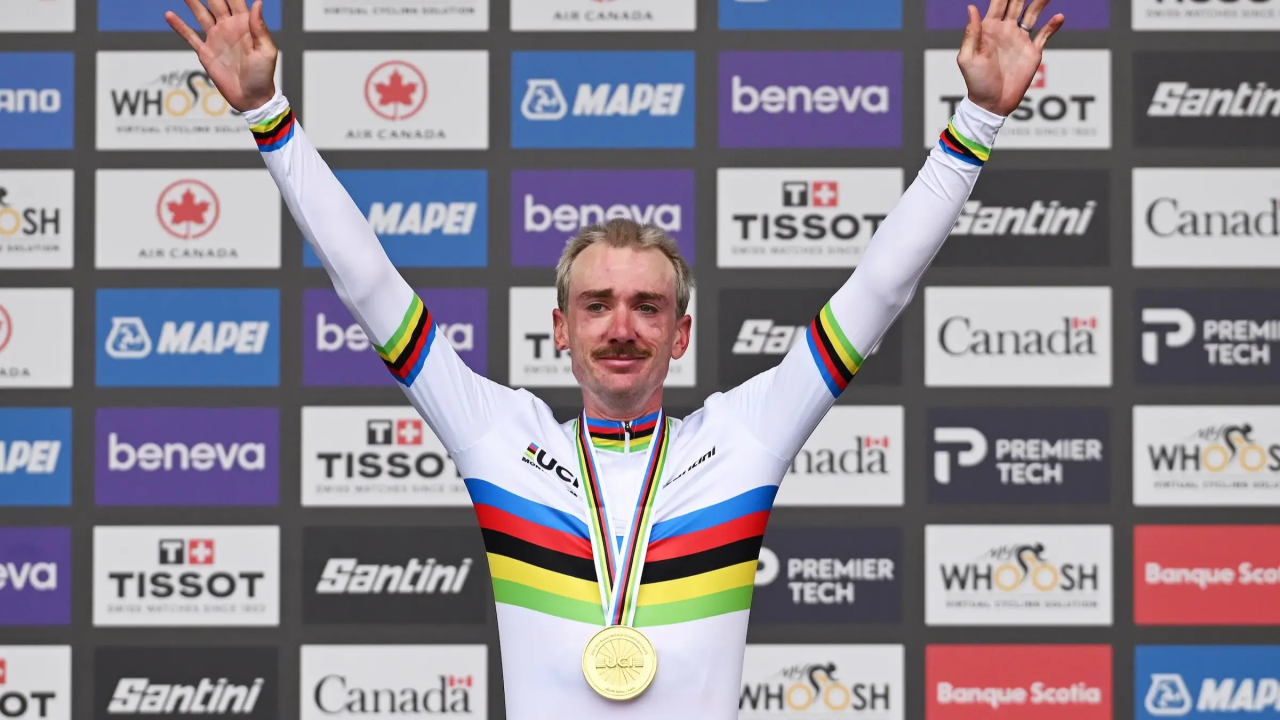
American Brandon McNulty wins the elite men's road race championship in Montreal. Photo: @DarioBelingheri/@GettyImages
America has world-class cyclists. The next opportunity is building their home stage.
American cycling’s performance at the 2026 World Championships in Montréal should command attention well beyond the bicycle industry. Brandon McNulty won the elite men’s road race, with Quinn Simmons fourth and Matteo Jorgenson eighth. Ashlin Barry won the under-23 men’s title on his 19th birthday. Those results show both established strength and exceptional emerging talent.
The women’s team brought proven international caliber as well, led by Kristen Faulkner, who won both road and track gold at the Paris Olympics and finished 21st in Montréal. Championship results are never guaranteed. But taken alongside WorldTour achievements such as Jorgenson’s consecutive Paris–Nice victories in 2024 and 2025, these performances show the depth of American talent competing at cycling’s highest level.
Much of that talent develops professionally overseas. Europe offers a concentration of major races, deep international fields, and proximity to professional teams. Riders go there to develop positioning, tactical judgment and the ability to perform repeatedly against world-class opposition, while adapting to the culture of professional racing. USA Cycling’s development leadership has emphasized the importance of European race days.
A strong domestic calendar helps more Americans reach that opportunity. It gives developing athletes the race experience and visibility to advance, while giving fans a chance to follow their progress close to home. The connection already exists: the 2026 USA Cycling Junior Road National Series includes eight events, with three offering selection opportunities for national-team programs. Expanding dependable domestic racing would give teams reasons to invest, athletes more opportunities to progress, and families a clearer route into the sport.
The commercial opportunity begins with how many Americans already ride.
PeopleForBikes estimates that 112 million Americans rode a bicycle at least once in 2024—the highest participation rate since its study began in 2014. Youth participation increased from 49% to 56% between surveys. These are potential connections to the sport, not an existing audience of 112 million racing fans. A well-produced domestic event can turn everyday familiarity with bicycles into interest in the athletes who ride them.
There is evidence of meaningful local value. Maryland’s official reporting credited the 2023 Maryland Cycling Classic with more than 80,000 attendees and $11.1 million in direct economic impact. Those organizer-reported figures describe community activity, rather than sponsor return. The event’s subsequent cancellation in 2026 also underscores why reliable financing and capable operations must accompany audience potential.
The opportunity for companies outside the bicycle industry is becoming more tangible. USA Cycling reported a 10% increase in participation across its 19 national championship events in 2025, with membership reaching approximately 70,000 and trending younger. Alongside rising youth ridership, this suggests an opportunity to engage both established enthusiasts and the next generation entering the sport.
The established audience also has commercial appeal. USA Cycling’s 2025 partnership materials describe its active racing members as typically college-educated, with household incomes of $150,000 or more and participation in six to seven races annually. Forty-one percent of members are between 35 and 54. While that profile does not represent everyone watching a race, it identifies a committed customer segment with meaningful purchasing power and repeated engagement with the sport.
For a bank, travel company, automotive brand, or healthcare system, a major race can connect that core audience with a much broader community. A stage race offers several days and multiple markets for customer hospitality, product experiences, and athlete storytelling. Free roadside viewing brings the competition within reach of families who may never have attended a professional sporting event. Community rides and beginner programs give spectators a way to participate.
The strongest partnerships would serve committed cyclists while making the sport easier to enter. Women’s racing deserves a prominent place in that investment. In France, television reach for the 2025 Tour de France Femmes and its accompanying coverage grew approximately 40% over the previous year, reaching 25.7 million viewers. That European audience does not guarantee American attendance. Still, it strengthens the commercial case for giving women’s racing the visibility, production quality and sponsorship support needed to build its own following here.
For young riders, the next step is turning inspiration into opportunity. Junior races, loaner bikes, affordable entry fees and welcoming local clubs can give a child watching from the roadside a realistic way to join the sport. Sustained support for coaching and teams can help those newcomers develop skills, build friendships and keep riding, whatever their competitive ambitions. Partnerships that connect road events with mountain biking, gravel, cyclocross, track and BMX can create more ways to participate. Investment in places to learn and ride—from neighborhood pump tracks and bike parks to velodromes—can extend a sponsor’s contribution well beyond race weekend.
For companies and decision-makers, the proposition is a multiyear partnership with measurable commercial outcomes: qualified customer contacts, hospitality results, brand lift and verified audience engagement. Participation growth and community impact should be measured alongside them. That gives a sponsor a clear basis for evaluating what its investment delivers and improving it each year.
America already has athletes capable of winning on the world stage, an established cycling community with purchasing power, and a new generation discovering the bicycle. A committed sponsor can help connect all three—building an event people return to, a sport more people can enter, and customer relationships that last beyond the finish line.